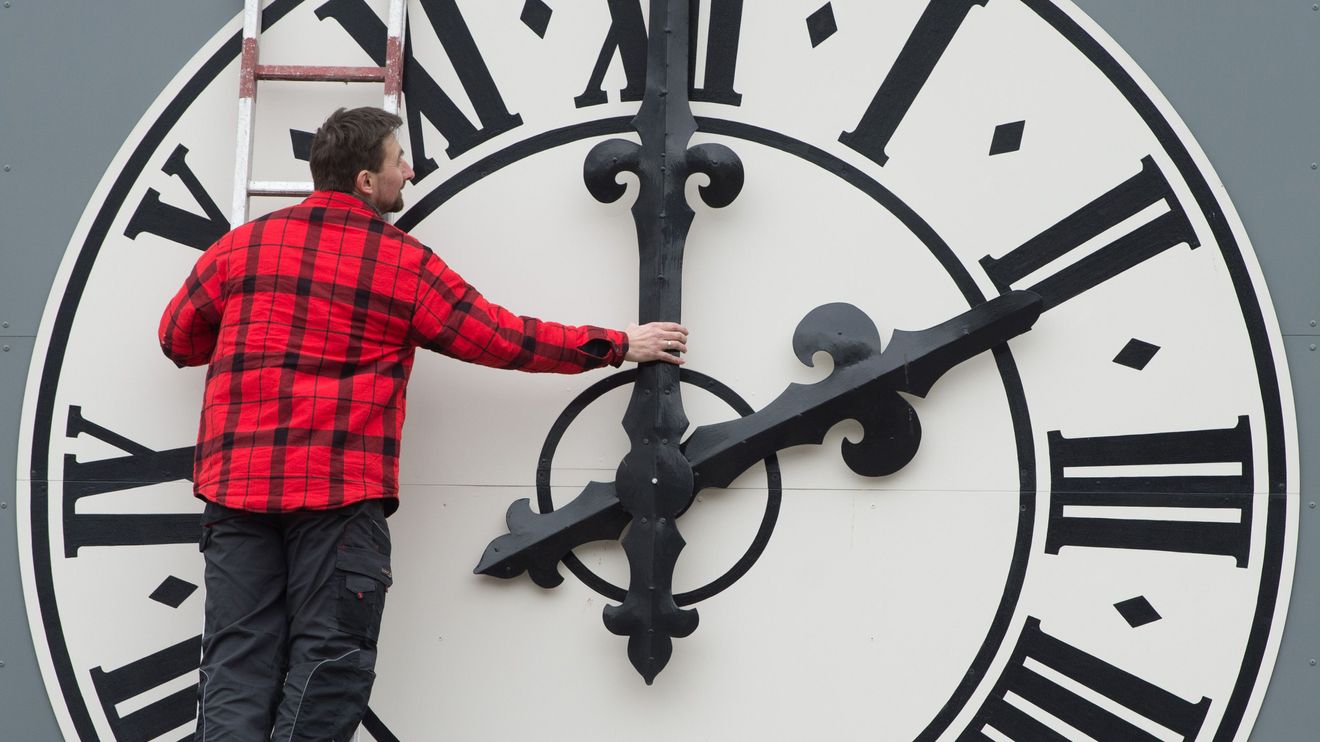
Yes, it will soon be time to fall back: Daylight-saving time ends at 2 a.m. on Sunday, Nov. 5. That means 2 a.m. becomes 1 a.m., so be prepared to adjust your clocks accordingly.
The practice started more than a century ago in the U.S. And it’s been subject to scrutiny and debate, especially in recent years.
So, why do we do it? And is there a case to be made for not doing it? Read on to learn more.
Who came up with this daylight-saving idea in the first place?
Some say that Benjamin Franklin, that wisest of Founding Fathers, invented daylight-saving time, although that’s not exactly true. When he lived in Paris, Franklin did observe that people were wasting good daylight when the sun was rising at 6 a.m. and they were not waking up until much later. He also saw it in economic terms: “An immense sum” could be saved, he said, “by the economy of using sunshine instead of candles.”
Franklin was being a bit playful. But the idea of daylight-saving was more or less formalized by a New Zealand entomologist — one George Vernon Hudson (1867-1946) — if you can imagine. Hudson liked collecting bugs, and more daylight meant more, well, bugs. So he wrote a paper proposing the time shift and presented it in 1895.
Eventually, the idea took hold. In 1908, a couple of Canadian towns adopted daylight-saving time. By 1916, it started to spread to Europe, with the thought being it would save on energy, an effort very much connected to World War I. And in 1918, the U.S. adopted daylight-saving time, as well.
And we’ve been doing it ever since 1918?
Not quite. In fact, the U.S. discontinued daylight-saving time by 1919 — at least on a national scale, although some states and municipalities carried on with the practice. It returned on a national level from 1942 to 1945, tied to World War II, after which it was again up to individual locales to decide whether they wanted to spring forward and fall back each year. The confusion finally ended in 1966, with the Uniform Time Act, which firmly established daylight-saving time as a national practice.
So the whole country is on board with this resetting of the clocks?
Again, not quite. States can still choose to exempt themselves — and Arizona and Hawaii are the two that don’t follow daylight-saving time. In Arizona’s case, the scorching heat is largely to blame, according to Arizona State University history professor Calvin Schemerhorn. After all, who needs another hour of sun when it’s already so hot?
As for Hawaii, the World Population Review website reasons that, due to the state’s location, “there are fewer variations between winter and summer daylight hours, so it makes sense to not have” daylight-saving time.
Are other states rethinking the practice?
Yes. Lots of them, in fact. According to a Wall Street Journal story, several states “are weighing bills regarding the time changes.” And there’s talk on the national level of doing away with the twice-a-year changing of the clocks, too.
Why does the change happen on Sunday at 2 a.m.?
Certainly, there’s less interruption in the middle of a weekend night. (And by the way, the 2 a.m. change is scheduled at that hour in each respective U.S. time zone — it doesn’t occur all at once across the country.) But the specific reason has to do with railroad schedules: When daylight-saving time was introduced more than a century ago, there was concern it would wreak havoc with train timetables. But Sunday at 2 a.m. was a dead zone, so to speak — no trains left New York at that hour, according to Time magazine. So the timing worked, and has remained in place.
When do we have to fiddle with our clocks again?
Daylight-saving time next begins on March 10, 2024, at 2 a.m. — when the time becomes 3 a.m., so you’ll need to adjust your clocks accordingly, again.
Read the full article here